

Most EU lobbying messages don’t fail on substance—they fail on usability
One of the more consistent patterns in Brussels communication is this: organisations invest heavily in getting the substance right, but far less in ensuring that their message actually works in practice.
In a recent closed-door workshop with a Brussels-based stakeholder group, this became very clear. The room was full of senior experts with a deep understanding of their files, strong analytical positions, and a clear sense of what they wanted to achieve. None of that was the issue.
The issue was translation.
Messages that were technically sound struggled to land outside of already aligned audiences. They worked in conversations with insiders—Commission officials, technical experts, member state representatives—but lost clarity and impact the moment they moved into more sceptical or non-specialist environments.
That gap is not unusual. But it is consequential.
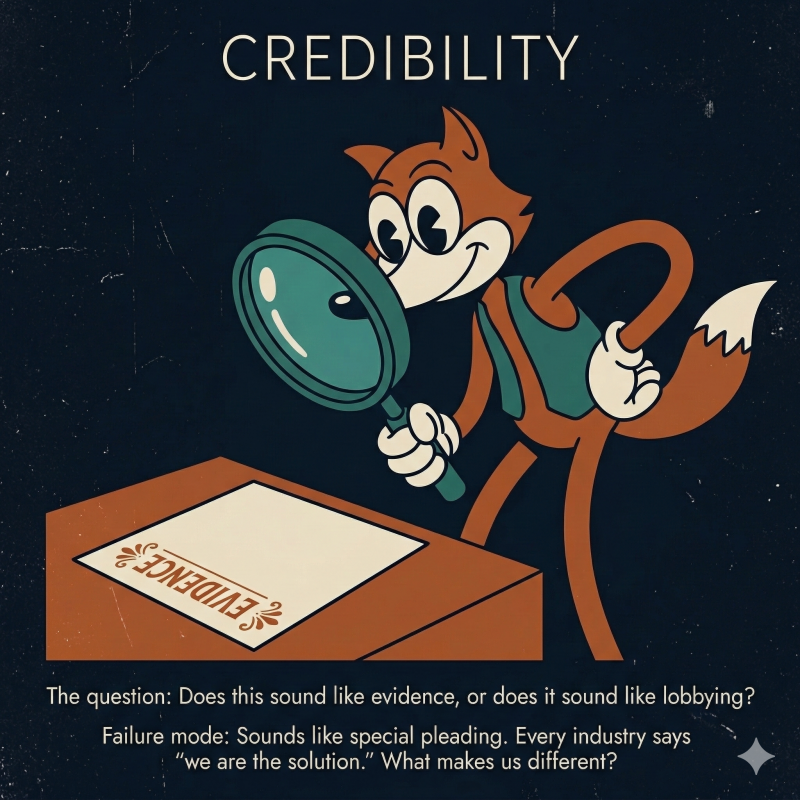
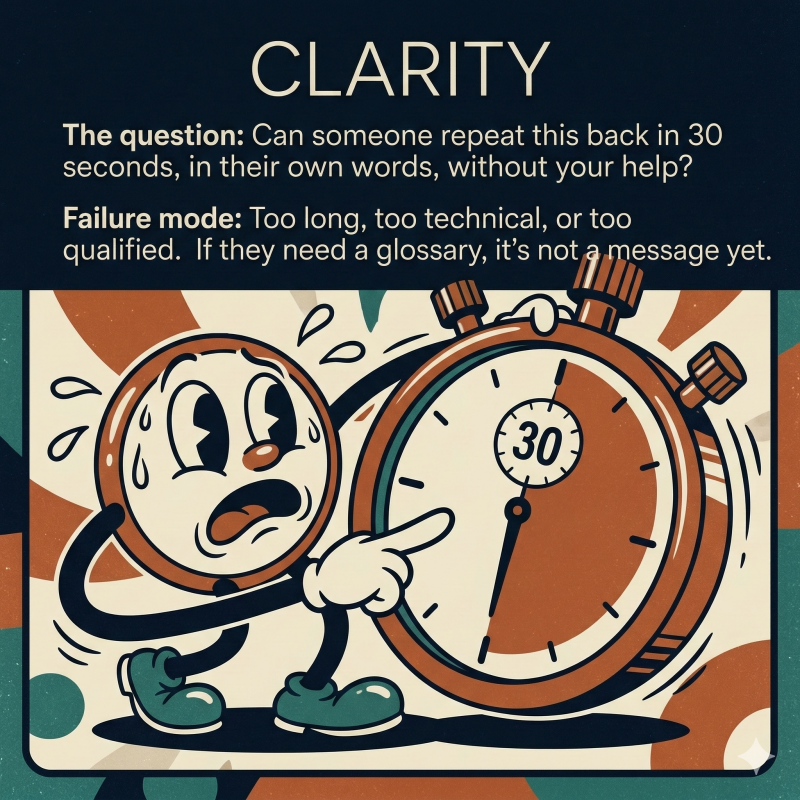
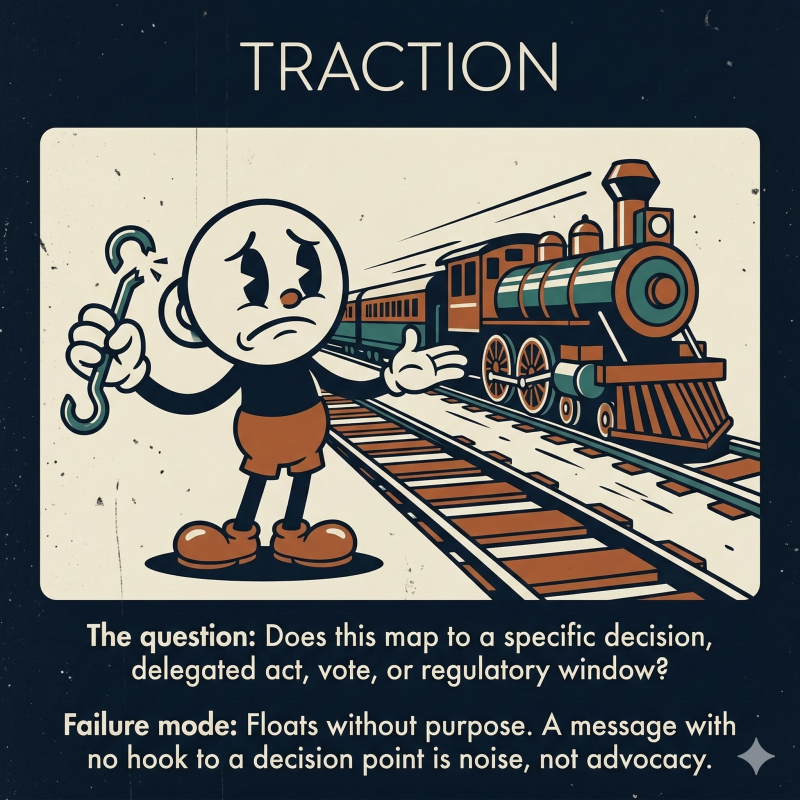
The three tests: clarity, credibility, traction
To make that gap visible, we used a simple framework throughout the day. Every message was tested against three criteria:
- Clarity: can someone repeat this back in 30 seconds, in their own words, without help?
- Credibility: does this sound like evidence, or like lobbying?
- Traction: does this connect to a specific decision, file, or moment?
What emerged was not a lack of quality, but a pattern.
Most messages scored relatively well on credibility. The substance was there, and the arguments were defensible. Where they struggled was clarity and traction.
Messages were often too long, too qualified, or too technical to stick. And even when they were clear, they frequently stopped at a conclusion rather than leading to a concrete ask. They described a position, but did not give the person on the other side of the table something they could actually do with it.
In Brussels, that distinction matters more than most people realise. A message without a clear link to a decision point is not neutral—it is simply ignored.
The real test: what happens under pressure
The most revealing part of the exercise was not the scoring itself, but what happened when messages were put under pressure.
When participants were asked to identify the question they least wanted to be asked, a clear pattern emerged. The hardest questions were not peripheral—they were directly linked to the most important policy files on the table.
This is a common dynamic. Organisations are often strongest where their position is already widely accepted, and most vulnerable where the stakes are highest. The result is that the messages that matter most are often the least prepared for external scrutiny.
Under pressure, two things tend to happen.
Either the message becomes more complex, in an attempt to demonstrate credibility, or it becomes more defensive, in an attempt to avoid the question altogether. Both responses weaken impact. Complexity loses the audience. Evasion loses trust.
The alternative is not simplification for its own sake. It is disciplined framing: acknowledging the challenge, answering it in clear terms, and linking it back to a specific decision or ask.
What this means for EU advocacy
For organisations working in and around EU policy, the implication is straightforward but often overlooked.
Getting the analysis right is only the starting point. What matters is whether that analysis can be translated into a message that survives contact with reality—time pressure, sceptical audiences, and competing narratives.
This requires a shift in how communication is approached.
- From completeness to clarity
- From positioning to action
- From internal alignment to external usability.
It also requires a more honest assessment of where messages are likely to fail. Not in friendly rooms, but in the conversations that actually shape outcomes: with a sceptical MEP, a critical journalist, or a Commission official under pressure to justify a decision.
If a message cannot be repeated, it will not travel. If it does not sound credible, it will not be trusted. If it is not tied to a decision, it will not matter.
And in Brussels, messages that do not meet all three tests rarely make it very far.
Add comment
Comments